
Skill
my human has ADHD
Your coding agent chases your ideas or forgets them. This one parks them.

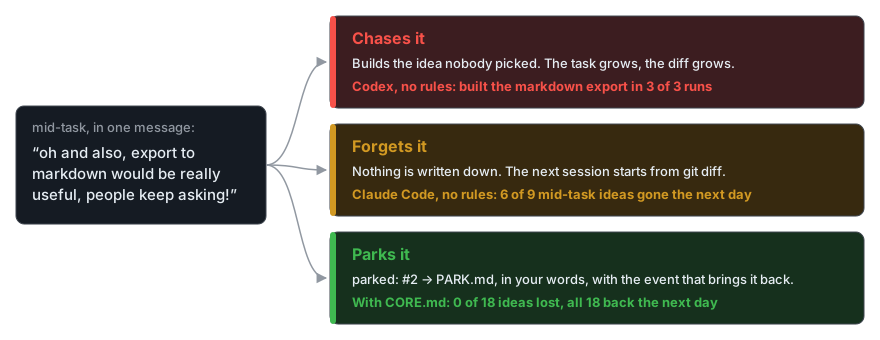
You say "oh, and also…" in the middle of a task. The agent has nowhere to put a thought that is not for now, so it does one of two things: it builds it (scope creep, work you didn't ask for) or it drops it (gone when the session ends). These 18 lines give it a third option. They were written by someone with ADHD; no diagnosis is needed.
Chase it or lose it
The rules
- Park, don't chase. An idea that is not the current step goes into
PARK.mdin your exact words, with the event that should bring it back. The agent saysparked: #3and returns to the step. "Add X" is a task, not an idea: it comes next. - Bring it back at the right moment. Only when you ask "what now", the task is done with nothing next, or the event happens. Up to 3 ideas as lettered options; one starts only when you pick it.
- One question, once. At most one lettered question per message. If you talk about something else, it is dropped; silence is not an answer.
- Proof, not praise. "Done" comes with the file or the test count.
- "You forgot." The idea goes back in the file marked
missed. No argument.
Install
Add CORE.md to the rules file your agent always reads: CLAUDE.md for Claude Code, AGENTS.md for Codex, .cursorrules for Cursor.
curl -fsSL https://raw.githubusercontent.com/fri3ndslab/my-human-has-adhd/main/CORE.md >> CLAUDE.mdPowerShell (cmd keeps the file in UTF-8):
cmd /c "curl -fsSL https://raw.githubusercontent.com/fri3ndslab/my-human-has-adhd/main/CORE.md >> CLAUDE.md"Or open CORE.md, copy the 18 lines and paste them. No script, no plugin, no account. Put it in ~/.claude/CLAUDE.md to have it in every project: it is about the person, not the repo.
PARK.md is a plain file in your project. Add it to .gitignore if your ideas are private; in a team repo, commit it, and the park becomes the shared list of what people actually said.
How ideas come back
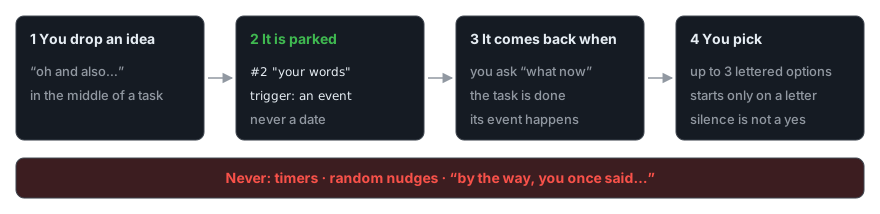
The trigger is an event ("before we publish", "when the settings page exists"), never a date: a reminder in seven days lands in the middle of something else. No obvious event means when idle.
- [ ] 2026-10-11 #2 "dark mode"  trigger: when the settings page exists
- [x] 2026-10-09 #1 "rename the repo"  trigger: when idle
- [-] 2026-10-02 #0 "rewrite in Rust"  trigger: when idle
- [ ] 2026-10-10 #3 "the webhook retry thing"  trigger: when idle  missed
[ ] parked, [x] done, [-] dropped, missed means the agent forgot and you said so. grep -c missed PARK.md is the honest number.
What we measured
Same scripted human, same toy project (a 30-line notes CLI), Claude Code and Codex, three runs per agent in each arm. The human asks for one feature, drops three ideas on the way, comes back the next day with "what now?", then says "you forgot".
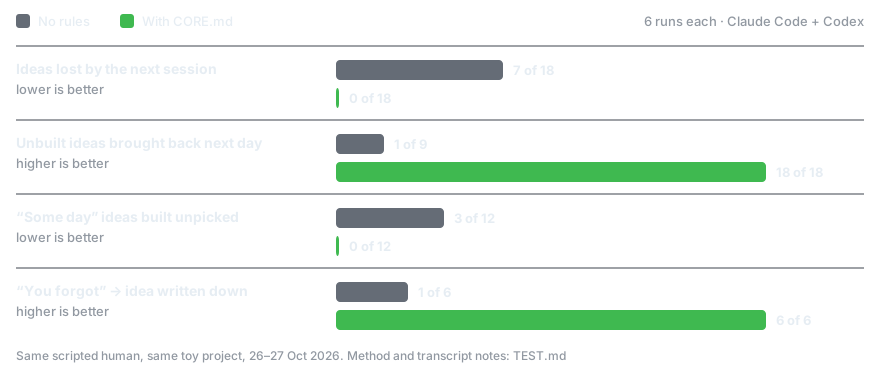
Without rules, Claude Code asked before building but wrote nothing down, so tags and markdown export were gone the next morning in all three runs. Codex built the markdown export every time although nobody picked it. With the 18 lines, nothing was lost and nothing was built that was not picked.
A 102-line long version scored the same and was slower (120 seconds per Claude run against 54), so the 18 lines are what we recommend. Every run, every miss and the text changes they led to: docs/TEST.md.
In our own workspace, where the park has a small script and a panel around it, it took 49 ideas in ten days: 19 were offered back, 9 were built, 8 were dropped on purpose, 32 are waiting for their event. Counts only; the ideas stay private.
FAQ
Is it only for ADHD? No. It was written for an ADHD brain, but the scripted human in the test was not ADHD-specific: everyone says "oh, and also…".
Why a rules file and not a memory plugin? Memory tools remember what the agent saw. This keeps one short list: what you said that is not for now, in your words, with the event that brings it back. You can open it, edit it and grep it.
Will my agent stop building things I didn't ask for? In our runs, Codex without rules built a "would be useful" idea in 3 of 3 runs; with the rules it parked it in 3 of 3.
Does it wear off in long sessions? It can. The rules sit in the file the agent reads every turn. When it misses one, say "you forgot": it goes back in the file, marked missed.
Does anything leave my machine? No. PARK.md is a text file in your project. Nothing is sent anywhere.
Does it work in Cursor? With any agent that reads a rules file. We measured Claude Code and Codex; Cursor is not measured yet.
How is it different from other ADHD skills? i-have-adhd and attention-span shape the agent's output; use them alongside this one. claude-adhd remembers unfinished threads with an indexer, nudges and a dashboard. This one has no code on purpose, and no reminders nobody asked for.
The long version
SKILL.md is the full working agreement: weights, counters, a now: task — step 3/5 line on every message and one two-minute action at the end. It scored the same as the 18 lines. For Claude Code:
mkdir -p .claude/skills/my-human-has-adhd && curl -fsSL https://raw.githubusercontent.com/fri3ndslab/my-human-has-adhd/main/skills/my-human-has-adhd/SKILL.md -o .claude/skills/my-human-has-adhd/SKILL.mdThen paste CLAUDE.snippet.md into your CLAUDE.md; Codex and Cursor need only the snippet.
Limits
- Nothing enforces the rules but the text; the
missedcount shows when the agent drifted. - One scenario, written by us, a toy project, three runs per agent per arm. No numbers from other people yet.